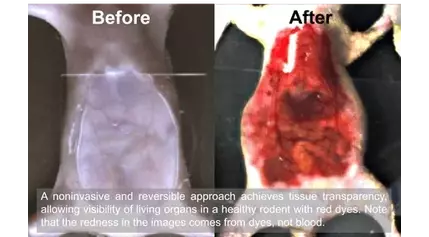
Common food dye found to make skin and muscle temporarily transparent
2025-10-27
21.5K
1.3K
283
Breakthrough Transparency Technique Revolutionizes Medical Imaging
Researchers at Stanford University have made a groundbreaking discovery that could transform medical diagnostics and treatments. By applying a common food dye to the skin, they have found a way to temporarily make tissues and organs transparent, allowing healthcare providers to visualize internal structures non-invasively. This remarkable technique has the potential to improve everything from identifying injuries to monitoring digestive issues and detecting tumors.
Unveiling the Hidden: A Game-Changing Transparency Breakthrough
Mastering Light Scattering to Enhance Tissue Visualization
Typically, when light penetrates biological tissues, it is scattered by the varying refractive indices of different structures, such as cell membranes and nuclei, making the tissue appear opaque. However, the researchers at Stanford have discovered that certain dyes, like the yellow food coloring tartrazine, can alter the refractive indices of tissues, allowing light to pass through more easily. By applying these dyes to the skin, they have been able to create a temporary "window" into the body, revealing the underlying organs, blood vessels, and even brain activity in living animals.The key lies in the way these dyes interact with light. Normally, adding a dye to a material would make it less transparent, as seen when mixing blue ink with water. But in the case of tartrazine, the researchers found that it has the opposite effect, reducing light scattering and enhancing tissue transparency, particularly in the red spectrum of light. This counterintuitive phenomenon has opened up a vast array of potential applications in the medical field.
Visualizing the Invisible: Transforming Diagnostic Capabilities
One of the most promising applications of this breakthrough is the ability to diagnose deep-seated medical conditions without the need for invasive procedures. By simply applying the dye to the skin, healthcare providers could potentially identify tumors, monitor digestive disorders, and even locate veins for blood draws, all through non-invasive visual examination.This technology could revolutionize the way doctors approach diagnostics. Instead of relying on invasive biopsies or complex imaging techniques, they may be able to simply examine a patient's tissue and detect underlying issues. This not only reduces the risk and discomfort for the patient but also streamlines the diagnostic process, potentially leading to earlier detection and more effective treatments.
Expanding the Frontiers of Medical Research
The implications of this discovery extend beyond clinical applications. The ability to temporarily make tissues and organs transparent opens up new avenues for medical research. Scientists studying the development of diseases, such as cancer, in living creatures will now have access to a much wider range of animal models, as the transparency dye can be applied to a variety of species, not just naturally transparent organisms like zebrafish.Furthermore, the combination of this transparency technique with advanced imaging technologies, such as laser speckle contrast imaging, could allow researchers to visualize an entire mouse brain or detect tumors hidden beneath thick tissues. This unprecedented level of visibility into the inner workings of living organisms holds the potential to dramatically accelerate our understanding of human biology and the progress of medical research.
Paving the Way for a Transparent Future in Healthcare
The breakthrough discovery by the Stanford researchers has the potential to transform the medical landscape, revolutionizing diagnostic capabilities, enhancing surgical precision, and accelerating medical research. By harnessing the power of light manipulation and dye-induced transparency, healthcare providers and scientists alike can now peer into the human body in unprecedented ways, unlocking new possibilities for improving patient outcomes and advancing the frontiers of medical knowledge.As this technology continues to be refined and explored, the implications for the future of healthcare are truly exciting. From less invasive procedures to earlier disease detection and more targeted treatments, the potential of this transparency technique is vast and far-reaching, promising a new era of enhanced medical understanding and personalized care.