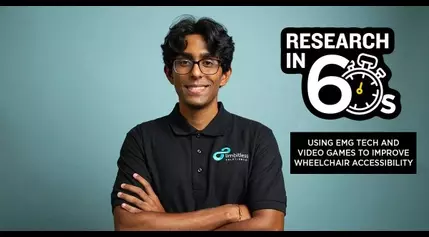
At the University of Central Florida (UCF), researchers are pushing the boundaries of scientific discovery, tackling some of the world's most pressing challenges. Through the Research in 60 Seconds series, students and faculty members share bite-sized summaries of their complex studies, shedding light on how Knights are working to improve our world.
Pavan Senthil: Bridging Engineering and Medicine for Transformative Impact
Pavan Senthil, a dual major in electrical engineering and biomedical sciences with a focus on neuroscience, has found a unique opportunity to merge his academic interests at UCF. As a researcher with Limbitless Solutions, Senthil is at the forefront of developing innovative bionic arms and Project Xavier, which utilize cutting-edge electromyography (EMG) technology to create assistive devices that aim to enhance the quality of life for individuals with limited mobility.Senthil's passion for biomedical engineering and his desire to make a tangible difference in people's lives led him to Limbitless Solutions, a UCF-based organization dedicated to developing accessible and inclusive technology. Through his involvement in these research projects, Senthil has been able to apply his academic knowledge to real-world challenges, directly impacting the lives of those in need.
Discovering Research Opportunities: Senthil's Journey at UCF
Senthil's research journey at UCF began with his prior experience in the AP Capstone program for research in high school. Determined to continue his involvement in research as an undergraduate, Senthil was presented with a wealth of opportunities through various programs and organizations at the university.The Office of Undergraduate Research's (OUR) peer-mentoring program and connections made with fellow student researchers in the Institute of Electrical and Electronics Engineers (IEEE) student organization were instrumental in guiding Senthil towards the diverse research avenues available at UCF. It was through his Honors Symposium course that Senthil discovered Limbitless Solutions and was encouraged to apply to their research program, a decision that has significantly shaped his undergraduate journey.
Mentorship and Inspiration: Shaping Senthil's Research Endeavors
Senthil's mentor, Dr. Albert Manero '12 '14MS '16PhD, the co-founder and executive director of Limbitless Solutions, has played a pivotal role in Senthil's research experience. Under Manero's guidance, Senthil has been able to align his research interests with his career aspirations in biomedical engineering, while also being challenged to expand his capabilities as a researcher.Senthil finds inspiration in the highly interdisciplinary nature of the Limbitless Solutions team, which comprises individuals from diverse backgrounds, including pre-medical researchers, engineers, and video game developers. This collaborative environment has allowed Senthil to learn from his peers, overcome personal and professional hurdles, and contribute to the team's groundbreaking projects.
UCF's Empowering Research Ecosystem
Senthil credits UCF's Office of Undergraduate Research (OUR) as an invaluable resource in empowering his research journey at Limbitless Solutions. OUR provides various incentives and support systems, including the Summer Undergraduate Research Fellowship, Student Scholar Symposium, and funding for research conferences, alongside Student Government. Additionally, OUR offers workshops to help new researchers develop essential skills, such as poster creation, academic writing, and grant application.Senthil's involvement in these OUR-supported programs has significantly boosted his confidence in his research abilities and allowed him to network with like-minded individuals on campus. The university's commitment to promoting undergraduate research has been instrumental in advancing Senthil's work at Limbitless Solutions.
Transforming Lives Through Accessible Technology
The research conducted at Limbitless Solutions, including Senthil's work on bionic arms and Project Xavier, aims to improve the quality of life for individuals with limited mobility. People with neurodegenerative conditions, such as amyotrophic lateral sclerosis (ALS), often rely on caretakers to perform basic tasks, compromising their sense of autonomy. The control systems developed by Senthil's team offer these individuals an alternative method of operating their wheelchairs, empowering them to regain a degree of independence.To complement the wheelchair control system, Limbitless' games team, led by Associate Professors Peter Smith '05 '12PhD and Matt Dombrowski '05 '08 MFA, has developed a video game training environment called Limbitless Journey. This game, created in collaboration with the Nicholson School of Communication and Media and the School of Visual Arts and Design, provides a low-stress training platform for users to practice the facial muscle-controlled wheelchair operation. The integration of video games as rehabilitation tools is a crucial aspect of the research at Limbitless, as it explores the effectiveness of such interactive experiences in clinical applications.The overarching importance of this research lies in its potential to promote inclusivity and equal opportunities for individuals with diverse needs. By designing assistive technologies with a focus on accessibility, Limbitless Solutions aims to empower marginalized communities and ensure that technology meets the needs of all users. This approach not only improves the quality of life for those with limited mobility but also fosters a more diverse and inclusive society, where everyone can contribute their unique perspectives and experiences.